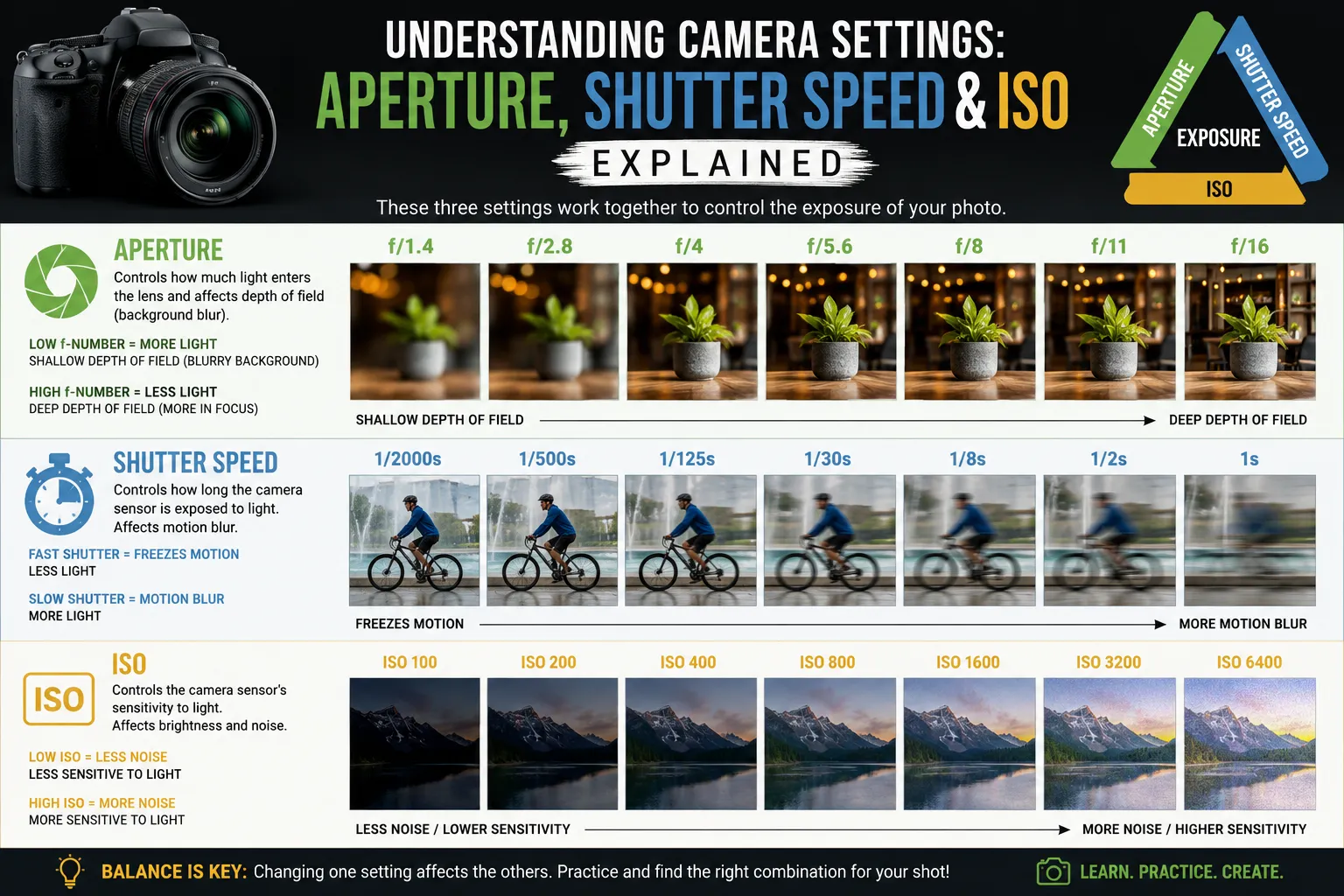
One of the most important things every beginner photographer should learn is the exposure triangle. The exposure triangle consists of three settings:
- Aperture
- Shutter Speed
- ISO
These three settings work together to control exposure, brightness, sharpness, and creative effects in photography.
What is Aperture?
Aperture controls how much light enters the camera lens.
Wide Aperture
Examples: f/1.8, f/2.8
- More light enters the camera
- Creates blurry backgrounds
- Great for portraits
Narrow Aperture
Examples: f/11, f/16
- Less light enters
- More depth of field
- Great for landscapes
What is Shutter Speed?
Shutter speed controls how long light reaches the sensor.
Fast Shutter Speed
Examples: 1/1000 sec
- Freezes motion
- Ideal for sports and wildlife
Slow Shutter Speed
Examples: 1 second
- Creates motion blur
- Ideal for waterfalls and night photography
What is ISO?
ISO controls sensor sensitivity to light.
Low ISO
- Cleaner images
- Less noise
High ISO
- Better in low light
- More image grain
Balancing the Exposure Triangle
All three settings work together. Changing one affects the others.
For example:
- Increasing shutter speed may require a higher ISO.
- A narrow aperture may require a slower shutter speed.
Practical Examples
Portrait Photography
- Wide aperture
- Fast shutter speed
- Low ISO
Landscape Photography
- Narrow aperture
- Tripod with a slower shutter speed
- Low ISO
Wildlife Photography
- Fast shutter speed
- Medium aperture
- Higher ISO if needed
Final Thoughts
Understanding camera settings gives photographers creative control over their images. Once you master the exposure triangle, photography becomes far more exciting and professional.